27.5.13

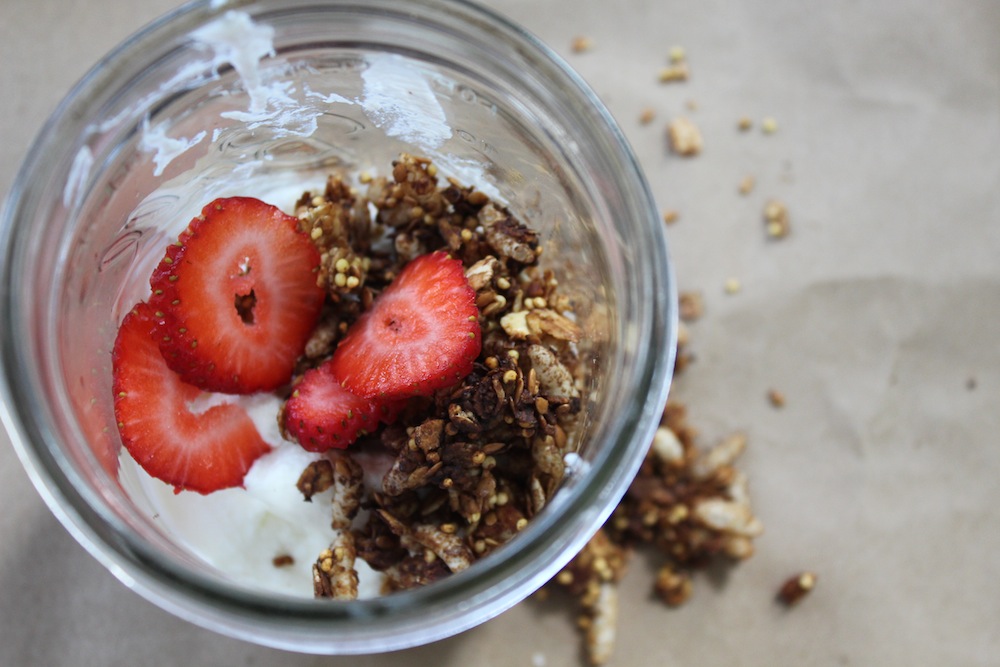
Multi-Grain Granola

No comments:


One of the best tricks to cooking cheap whole food is using what you can find on sale, or is usually a good price where you are. Granola, while it seems like an expensive thing to make, can actually be a great price if you use the things on hand. The other cool thing about granola is that it can take a lot of variation. It is basically just roasted grains with some kind of thing to stick them together (honey, syrup, oil, etc.).

We love granola because in literally 15 minutes, I can put together a big batch that will last us for a couple of weeks. It is filling, healthy, and easy to grab a handful of for a snack. It is wonderful with yogurt, good with milk, and great just by itself. We use granola instead of store-bought cold cereals, which have so much sugar and preservatives in them and are just plain expensive. 

This recipe is one I have developed from the things I found at my whole foods store and local grocery for reasonable prices. You can substitute in whatever grains/ seeds/ nuts you can find. Make it as complex or as simple as you like. Think of this as an example... use your imagination to make your own!

I'd like to list the prices for you so you can see what I make this for... but I had all the ingredients in my kitchen and honestly haven't a clue what they each cost at this point. It has been a couple weeks since that grocery run. I can tell you for those of you in Oklahoma City that I got the oats as "old fashioned oats" at Buy For Less in Bethany, I got the flax, millet, honey, and almonds at Sprouts (63rd and May), and I got the puffed rice and cinnamon at Spices of India (39th and Portland).

Pick your grains first. As I already said, I used oats, millet, flax, and puffed rice for my grains. You can use as few as one grain (probably oats), or as many as you like. Think rolled quinoa, buckwheat, rolled spelt, rolled amaranth, rolled wheat berries.


Then, pick nuts. Again, you can do as few or as many as you like. I used almonds, because they were on sale. You could use peanuts, pecans, cashews, walnuts, etc. Also, think about spices. I just used cinnamon, partly because it was cheap and partly to keep the flavor of the granola simple since I already had so many grains.


Finally, choose what you are going to use to hold the granola together, usually a sweet syrupy part (think honey, agave nectar, maple syrup, molasses, sorghum) and an oil part (such as vegetable oil, olive oil, coconut oil, or almond oil). The more "clumpy" you want it, the more sticky stuff you add. For mine today, I used honey and vegetable oil. At the amounts I used, it does form clumps but they fall apart fairly easily.


Mix all your ingredients together, and spread out on a cookie sheet. Cook at a high heat, I did 400F (200C) until granola is nice and toasted. It cooks really fast, keep a good eye on it. Mine cooked for about 15/20 minutes. Then take it out, and let it cool at least somewhat on the cookie sheet before scraping it off. Cooling it on the sheet allows it to dry out and clump together some. However, if you wait too long to scrape it up, you will end up with quite a job on your hands, as it will probably stick!

There you have it! Granola! What I did was make a few small batches until I figured out how I liked it -- what grains, how clumpy, how sweet, etc. I would recommend you do the same, until you figure out exactly what you like.

Here is exactly what I used for mine today: (warning: this granola is not very sweet at all. If you want it to be sweet, add more honey or some sugar or you could always eat it with sweet fruit or yogurt.)

Multi-grain Granola (print recipe)
4c rolled oats
3c puffed rice
1c flax seeds
1c millet
1c almonds, chopped
1/3c honey
1/4c vegetable oil
3Tb cinnamon

Preheat oven to 400F. Mix all ingredients in large bowl. Spread on cookie about 1/2 to 1 inch thick. Bake for 15-20 minutes, until golden brown. Let cool. Scrape off cookie sheet and place in sealed jar. Keeps for a long time. 


24.5.13

Whole Foods

2 comments:


I find it funny that "whole foods" is such an expensive, upper-class, exclusive phenomenon surrounded by strange words and fads. True "whole food" is such a simple, obvious thing, that it seems to me that people must have to work very hard to make it so crazy and complicated. There is this idea that you either are a normal person who eats McDonalds and cheap frozen foods, or you are a rich hippie who can afford to eat vegan, paleo, GAPS, organic, raw, Whole Food, health nut stuff. I would like to argue that these are both silly and based on wrong assumptions.

Basically, the idea behind real whole food is that we modern folk eat abnormal things and this makes us chronically sick. This is true for several reasons, all of which fall under the heading of "we weren't made to eat this way." Modern food tends to:
1. Introduce chemicals
2. Process out nutrients
3. Kill all the bacteria

This is bad. First, we were not made to ingest so many chemicals. With the dyes, flavorings, preservatives, etc, present in our fast food, frozen food, canned food, packaged food, we are getting so many chemicals that we our bodies were never meant to process, and this causes our system to have to work overtime to try to deal with all this foreign stuff we are dumping into ourselves.

Second, processed food has so many of the nutrients taken out of it. White flour and white sugar are so processed that none of the original nutritional value of the things they are made from remains, and all we have left is empty calories filling up our bodies without giving us the vitamins we need. This is also true of pretty much any processed food -- the nutrients are greatly reduced or completely gone. Many times companies "add" vitamins in an attempt to make things seem healthy again, but these added vitamins are often in a form that our bodies cannot really absorb or use because they aren't natural (see above paragraph on chemicals). Our bodies store the empty calories as fat, and we gain weight while remaining malnourished!

Finally, we are obsessed with getting rid of bacteria. Bacteria are bad, bad, bad. They make us sick, they are horrible little germy things. We buy products to "kill 99.9% of bacteria!", and dump bleach all over our houses and antibacterial solution all over our hands. We also make darn sure that there are NO bacteria in our food. Now, of course, many bacteria are indeed bad. They do indeed make us sick. We indeed should take measures to avoid these pathogenic bacteria. However, what we have too often lost sight of is the fact that bacteria are also necessary to life! Our digestive system requires bacteria to digest food! These beneficial bacteria are called "probiotics" and we really need them. Unfortunately, the unnatural ways that we process food (such as feed lots) produces mutated really horrible bacteria (such as pathogenic E. coli), and we have to pump antibiotics into our food then to make sure we don't die. This virtually eliminates even the bacteria our bodies actually need to thrive and to work properly we have to replace them -- hence the popularity of fad/"whole food" probiotic things such as yogurt, kefir, kombucha, etc.

In a nutshell, these are some of the main things wrong with the way we eat. There are whole books written on the subject, degrees in the issue, and much much more to say and better ways to say it... but if you want to hear more, you can go read the books. (see the end of this post for a list of resources) Whole food, then, is basically the idea of feeding our bodies what they were made to process. This is raw foods (rather than over-cooked, which kills many nutrients), chemical-free foods (this is the idea behind the "organic" fad), naturally grown foods (eliminating the need for antibiotics since they don't have the mutated superbad bacterias that some abnormally grown stuff has), and non-processed foods (such as whole grains and non-sugary foods). Fortunately, you do not have to be rich to eat this way! I am a rather "poor" recent college graduate, and I feed my little family of two and a half (the six-month-old only counts as half, food-wise) on less than $200 per month, without growing a garden or keeping a goat or anything like that. We eat mostly whole food, and while certainly not perfect, I think that we eat quite healthily. We are not vegan or vegetarian or paleo or GAPS or dairy free or gluten free, or anything like that: we just try to eat real food. If I can make it at home out of all ingredients that I know, then I try to. This does take a bit of time in the kitchen, but I think the pay off is worth it!

SO, all that to say, I really think that eating "whole" food is well worth the time and effort, and does not have to cost an arm and a leg. I think that eating "whole" food does not have to take over or define your life. I think our diets can often accommodate a LOT of "wholification" (if I may make up a word) long before they become ridiculous.  I think it can be as cheap if not cheaper than "normal" food. And I'd like to prove it to you, here on this blog. Stay tuned. :)


Books/ resources:
 Note, the opinions in these books are not necessarily all shared by me. I think all of these people can get a bit carried away and sensationalist. Nevertheless, most of them do make some good points.

Folks, This Ain't Normal  by Joal Salatin. Talks about the "abnormality" of modern food. See: http://www.folksthisaintnormal.com/

Fast Food Nation by Eric Schlosser. Talks about the nutritional, moral, and social problems of modern fast food. See: http://www.amazon.com/Fast-Food-Nation-Dark-All-American/dp/0547750331

http://allnaturalfoods.com/ is a website about natural foods, diseases, and the relationship between food and whole health.

8.8.12

Spiced Orange Tart

No comments:

Oranges are really cheap at my grocery store right now. Now, I do like oranges, but I have some sort of mental block against just picking them up and eating them as a snack.

I'm not sure why... maybe it's because when I was little I chewed my fingernails and so I could never really peel oranges very well and they were a lot of work to eat for little me.

Maybe it is because one time when I was around 6 I ate an orange by slowly and messily dissecting it little juice-filled packet by packet.... on top of one of my favorite books... thereby accidentally banishing that book to sticky, orange-covered oblivion. Poor book. That must have traumatized me or something.

ANYWAY, for whatever reason, oranges always sound really good at the store, and they are cheap, so I buy them... and then they sit in my fridge for several months until they are sufficiently green and fuzzy to be sent to the compost pile. But not this time! This time I decided to take control of the destiny of the oranges in my fridge and make something of them. I adapted this recipe a bit for the custard insides: http://www.crumbblog.com/2012/03/pretty-in-pink-blood-orange-tart.html, and I adapted this recipe for the spice shortbread crust stuff: http://smittenkitchen.com/blog/2008/11/the-great-unshrinkable-sweet-tart-shell/

First off, the tart shell. See, the shell has to sit in the fridge and chill for a little while before you bake it, so it is a good thing to start off with.


Cinnamon and nutmeg in liberal helpings take this tart crust from pretty darn good to a spicy, wonderful thing that makes your kitchen smell like heaven.


Flour, icing sugar, butter, spices, and an egg combine together into crumbly goodness. The trick to this tart crust is first to cut in the butter until it is very coarse, then to add the egg and stir in the egg until the crust begins to clump together like the last picture above shows.

When it begins clumping like that, dump it out of the bowl onto your countertop and gently fold it over and over until it sticks together into a rough crust.
This will take a while, and you will be tempted to mash it together and knead, but you must resist the temptation because that will take away all the lovely flakes of butter in the crust. Gently press the crust into a square, then fold it in half (sort of roughly since it is all crumbs), press it together again, fold again, etc, until it is done.


Then take this rough crust, wrap it in saran wrap, and place it in the fridge for a while so that the moisture can work all the way through it and make it easier to work with.


Roll it out on plenty of flour, and put it into a tart or pie pan, then press it with your fingers until you like the shape.


Freeze this shell now, for about 20 minutes or until it is sort of firm. This will help it keep its shape while baking.

Meanwhile, lets begin to talk about the insides of this tart. Orange juice, lemon juice, spices, and eggs combine to make a lovely custard. I didn't have a lemon, so I used a lime instead. It worked.


Juice oranges until you are tired of juicing oranges, then juice a few more...


Aren't egg shells pretty?

You are going to cook the mixture until it turns into a custard. This is not hard, you just have to heat it up slowly and stir it constantly or it will curdle. I am a very impatient, forgetful person so mine usually curdles. I then just pretend that is how it was supposed to be, and no-one is the wiser. It doesn't affect the taste, just the looks... and if whoever you are feeding it to hasn't made custard before, perhaps you too can convince them that it is supposed to be a bit lumpy.

While your custard cools, you can pull your tart shell out of the freezer, poke it all over with a fork so that it doesn't bubble, and bake it.

Once it is baked, pour your custard into it.


Now, pop it back in the oven to bake the custard. I like to sprinkle some cinnamon and nutmeg over the top of it before baking it, because it is pretty, hides my lumpy custard, and tastes good.

And then you eat!


Spiced Orange Tart Recipe

Crust ingredients:
1 and 1/2 cups flour
1/2 cup icing sugar
1/4 tsp salt
1 stick plus 1 Tbs cold butter
lots of cinnamon and nutmeg... like, probably 2 Tbs of each. At least.
1 large egg. Or two or three eggs the size of the eggs I use, which are laid by little farm chickens in my mother-in-law's barn.

Mix together flour, sugar, salt, and spices. Cut butter into cubes, then cut it into the flour mixture until it is in large crumbs. Beat the egg, then mix it in. Keep stirring until the mixture begins to clump, then turn out on counter and gently knead until it clings together. Wrap in saran wrap and place in fridge for 10 to 20 minutes, or up to a day.

When ready, roll out crust and press into pan, then freeze for about 20 minutes or until slightly firm. Poke all over with fork, cover with aluminum foil, then bake at 400 degrees F for 20-25 minutes. Remove foil and bake for another 10 minutes to brown crust.

Custard ingredients:
2 tsp orange zest
3/4 cup fresh orange juice
2Tbs lemon or lime juice
3/4 cup sugar
3 whole eggs
1 egg yolk
1/4 cup butter, cut into cubes
1 Tbsp each of cinnamon and nutmeg

Whisk all together in medium saucepan and heat slowly while stirring constantly. Heat until mixture thickens enough to coat back of spoon... a very runny custard.

Pour custard into crust and bake at 350 degrees F for 25- 30 minutes until custard is cooked. This means that it will be a bit bubbled at the edges but the middle will still wobble some.

Chill in the fridge until ready to eat.

Enjoy!